I recently came across an article about bottled water, and it provided me with even more reasons not to use them. If you or someone you know still uses bottled water, you need to read this, or share this article with them.
1) Bottled water is not tested, nor do the companies have to tell you where they get it from. Tap water is regulated, and your city must submit reports to the EPA listing the results, and disclose the results to the public. Laboratory results of bottled water have shown far worse performance than tap water. A company could literally fill up bottles from the tap and sell them as "Pure Glacier Stream" and you would have no idea if that was true or not. Approximately 25% of bottled water comes directly from municipal (city) tap water.

2) It's expensive. The average price of bottled water is 240-10,000 times more expensive than tap water. Per gallon, it is more expensive than gasoline! Over 90% of the cost of bottled water is associated with the bottle, lid and label.
3) Plastic bottles made from PET and Tetra Paks have a higher rate of leaching into the bottled water, the longer it sits in the container. The results continue to come in, and they don't look good. Many of the leaching substances are hormone-mimicking, like estrogen.
4) Most people cannot taste a difference. Here is a blind statistical study we conducted that compared bottled water, tap water and filtered water. Our testers could not taste a difference.
5) Water bottling companies destroy the water aquifers of communities. Most of the water bottle companies are large corporations, like Coca-Cola, Nestle, and Pepsi (to name a few). They come into a community, extract the water for almost no cost, dry up the ecosystem, then take their profits and leave.
6) Manufacturing the plastic bottles (from oil), pumping and filling the bottles, packaging and transporting the bottles greatly increases carbon emissions. Most of the time, the bottles are shipped far away from where the water is collected and filled, so this can have a huge impact on our carbon footprint.
7) Most plastic bottles are STILL not recycled. Only 1 out of every 4 bottles (about 25%) are actually recycled. Even if that number was 100%, recycling doesn't make the problem go away. We need to REDUCE our usage, to avoid the carbon impact in the first place (see #6)
Recommendation: Use a reusable aluminum water bottle filled with filtered tap water. You may not even need to filter the water depending on where you live.
Here is a good pamphlet developed by the Sierra Club that summarizes these same arguments against bottled water.
1) Bottled water is not tested, nor do the companies have to tell you where they get it from. Tap water is regulated, and your city must submit reports to the EPA listing the results, and disclose the results to the public. Laboratory results of bottled water have shown far worse performance than tap water. A company could literally fill up bottles from the tap and sell them as "Pure Glacier Stream" and you would have no idea if that was true or not. Approximately 25% of bottled water comes directly from municipal (city) tap water.
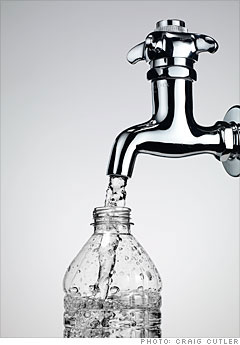
2) It's expensive. The average price of bottled water is 240-10,000 times more expensive than tap water. Per gallon, it is more expensive than gasoline! Over 90% of the cost of bottled water is associated with the bottle, lid and label.
3) Plastic bottles made from PET and Tetra Paks have a higher rate of leaching into the bottled water, the longer it sits in the container. The results continue to come in, and they don't look good. Many of the leaching substances are hormone-mimicking, like estrogen.
4) Most people cannot taste a difference. Here is a blind statistical study we conducted that compared bottled water, tap water and filtered water. Our testers could not taste a difference.
5) Water bottling companies destroy the water aquifers of communities. Most of the water bottle companies are large corporations, like Coca-Cola, Nestle, and Pepsi (to name a few). They come into a community, extract the water for almost no cost, dry up the ecosystem, then take their profits and leave.
6) Manufacturing the plastic bottles (from oil), pumping and filling the bottles, packaging and transporting the bottles greatly increases carbon emissions. Most of the time, the bottles are shipped far away from where the water is collected and filled, so this can have a huge impact on our carbon footprint.
7) Most plastic bottles are STILL not recycled. Only 1 out of every 4 bottles (about 25%) are actually recycled. Even if that number was 100%, recycling doesn't make the problem go away. We need to REDUCE our usage, to avoid the carbon impact in the first place (see #6)
Recommendation: Use a reusable aluminum water bottle filled with filtered tap water. You may not even need to filter the water depending on where you live.
Here is a good pamphlet developed by the Sierra Club that summarizes these same arguments against bottled water.