Tuesday, September 8, 2015

Should you replace all your non-vegan items immediately or wait?

Since I’ve gone vegan (over one year now as of Sept 2015), I've been thinking more about the question below:


The question was asked to Emily Moran Barwick during one of her recent speeches.

At first, my thought was that I should wait for the items to wear out or run out, then replace them with vegan options. But now I’ve got a little bit more clarity around what I should be doing. 

Let's discuss two main items:
  • Prepared Food 
  • Clothing

FOOD

The first issue is around food that is already cooked and prepared, should I just eat it because the "damage is done” or should I decline it? 

At first, I did think that it would be okay to eat already prepared food because "hey, someone ordered pizza and the damage is already done so you know, we shouldn't let the food go to waste."

After a while, a lot of things started to change. First of all, as I have seen more and more videos about how bad the meat industry is, I don’t want to eat the food anymore. In fact, it makes me sick, and I don't have the desire to eat something that came from animals, since I know what the animals went through. 

Secondly, I thought about the leftover food that would go to waste. I don't want to waste food, and don't want the food ending up in the landfill. However, I realized that if there are leftovers, someone else will likely eat them, or take them home. If they normally would eat meat products for one of their future meals, but instead they ate the leftover meat from the event that I didn't eat, then that saves one more meal that otherwise would have been consumed. Overall, there would be one less meat-based meal that was consumed. 

The other thing I realized was that eating the prepared meal was giving the illusion that whomever made the decision to order that much pizza (or food) at the catered event or at the conference was estimating the amount correctly, since there weren't any leftovers.


If they ordered a certain amount of food and if I eat it, then I’m giving them incorrect feedback that they ordered the right amount. Next time, they will simply order the same amount. However, if I don't eat it (and I can put away quite a bit of food), then maybe it will send a signal to them that they ordered too much food, and next time they'll cut back on the amount, This is where the true impact will occur in order to reduce the amount of meat consumed. It’s a little bit of a stretch, but in my mind I can justify that. Maybe in the long run it will pay off if everybody who is vegan does this, then it would make a difference. 

CLOTHING/PRODUCTS

The other issue is around the products that you already own, such as clothing or personal care products that is non-vegan. Should you just continue to use those, or should you go and replace them all? 


For example, if you have a leather belt or leather shoes or a leather jacket, or you have personal care products like shampoo, make-up, deodorant or cologne that were tested on animals, what should you do with the items? 

At first I felt that since you already purchased it, the "damage was already done," so you might as well just use it up. Then a couple weeks ago I watched Emily's BiteSizeVegan.com video, and she started to change my mind about this. 

Here is why I'm changing my mind...

First of all, when you are wearing those products or keeping them in your home, you’re basically telling people that you support the use of animals for leather. You're giving the illusion that you support these items.

It started to create a conflict in my mind having them around the house. That's why I suggest you replace them as soon as possible. However, if you really can't afford to replace the products (it’s the only pair of shoes you own), then I think you should replace those items as soon as possible. If you have a lot of non-vegan items, replace them slowly, so it doesn't cost so much at once.


Here is another reason why: When you go buy a new item that is vegan-friendly, you are sending a signal to the marketplace with your money. 
"Every time you spend money, you're casting a vote for the kind of world you want." -Anna Lappe
When you buy a vegan-friendly product, you are supporting the company, and telling them that what they offer is valued and they should continue to make it. If you wait until the item wears out or runs out, that could be months or years later before you support them, and that might be too late for some small businesses taking a chance with their vegan offerings. Your purchases also send signals to other companies that there is a market for vegan items, and it might get them to start offering similar types of products

That’s probably one of the biggest reasons why I’ve changed my mind about replacing the items I own.

What items are you struggling with replacing? Add some comments to the bottom of the blog if you want to discuss....

Thursday, December 25, 2014

The Environmental Impact of Human Drug Addictions

Our human relationship with addictive substances dates back thousands of years. There is evidence of alcohol consumption as far back as 10,000 BC, while tobacco seems to have been grown in the Americas for around 8000 years. Meanwhile, the energy-giving properties of coffee were discovered in Ethiopia around 800 AD. Besides these popular recreational substances, opium was extracted from poppies by the Sumerians for medicinal purposes around 2000 BC, and the coca plant is traditionally used for therapeutic and ceremonial purposes in the Andes.


As news of their psychoactive potency spread, the use of these addictive substances grew and techniques were developed to intensify their effects, such as producing spirits, purifying opium and learning that smoking tobacco and crack delivers a greater hit.

Addiction was identified as a problem as long ago as the 17th century, but this did not hinder the growth of these industries. Increased consumption fueled alcohol production in Europe in the 1500s and commercial tobacco production began in the 1600s, though coffee did not reach popularity till the 1700s and recreational use of opiates and cocaine followed in the 1800s. Mass production of these psychoactive substances didn’t just place more people at risk of the health problems associated with heavy use, but these industries also have a significant environmental impact.

Here are the most common addictions:


To learn more about how these addictions impact the environment, click the links above, or visit the Steps to Recovery website.

Thursday, September 18, 2014

Top 10 tips for planning a green wedding

One of the more popular wedding themes with couples is planning a ceremony that is "eco-friendly". Here are some ideas on how you can minimize how much impact your wedding has on the environment with these tips, so you don't feel guilty on your big day.

1. Gown

Consider alternative dress materials such as hemp, bamboo, organic cotton, wool or silk. Consider renting or borrowing a vintage gown or jewelry. Don't forget about the makeup either, and select all-natural products that are safe for the environment

Find all-natural beauty products >>>

2. Honeymoon

Stay local or choose an eco-friendly tourism location. You can choose from a fancy resort or a simple "bare-bones" place to stay. You could also skip the plane trip, and opt for a longer (but more romantic) train ride. If you decide to fly far away, consider offsetting your carbon footprint.

Fancy resort in Puerto Rico >>>
Simple island vacation to Dominica >>>

eco friendly honeymoon

3. Photographers

Select a photographer that uses digital proofs, instead of printing them out. This will save paper, chemicals, and time for both of you. Have your friends share their digital photos with guests online to avoid the single-use disposable cameras.

Search for digital cameras >>>

4. Rings

Consider something other than diamonds, which usually come from conflict-torn regions of the world with unsafe labor practices. There are synthetic diamonds, "conflict-free" diamonds, wooden bands, and recycled metal bands. Of course, hand-me-down and reused jewelry is always the best option.

Search recycled rings >>> 
Learn more about how diamonds are mined and sold at http://diamondfacts.org/

5. Invitations

Consider post-consumer recycled paper, handmade cards from reused paper, alternative inks such as vegetable or soy-based inks. Instead of mailing invitations that are bulky and multiple sheets of paper, consider postcards or online invitations (e-vites).

Search for recycled wedding invitations >>>

recycled wedding invitations

6. Decorations

Select organic and local flowers whenever possible. Live plants can also be used for a dual purpose, as decorations and as gifts to guests. For candles, select beeswax or soy-based options that reduce toxins for your guests.

Find soy-based candles >>>

7. Location

To reduce travel time and distance, have the wedding and reception in the same place. Pick a unique, local spot, such as an art gallery, garden, farm, non-profit meeting space, green hotel or organic restaurant.

8. Gifts

Instead of receiving gifts that you probably don't need, ask for charitable donations to a good cause. For gifts you need, consider registering at places with eco-friendly options (local, fair-trade, handmade, organic, etc). Other great gifts include community-supported agriculture (CSA) subscriptions from a local farm, museum and park annual passes, organic sheets and bedding, or gift certificates to organic or vegan restaurants.

9. Bachelor/ette parties

When ordering the alcohol for the party, choose local and organic wine and beer. Look for eco-friendly shuttle or limousine services to get you back and forth safely.

Find organic wine bottles and boxes >>>

10. Food and Drink

Select caterers that offer local, organic and seasonal foods and beverages. Consider vegetarian and vegan options for your guests, along with organic and cruelty-free meat, and wild caught seafood. Provide compost and recycling options at the venue, use real silverware, plates and utensils, or select compostable options.

Find compostable plates, utensils and cups >>>

green compostable plates and cups


Greening your wedding doesn't have to be difficult or more expensive. You can let your guests know that you put great care for the environment into your wedding plans. After all, this will be the first thing that guests will see from the new couple, so you want it to be the right message that reflects who you are as a couple.

Wednesday, August 20, 2014

12 step process to slowly switch from a meat-based to vegan diet

If you had asked me 5 years ago that I would be eating a vegan diet, I would have laughed out loud, and bet you a million dollars you would be wrong. And you would be a millionaire now...

Although I've only been vegan for one month, I don't see any way I will go backwards, as I think it's the only diet I can live with now, and not feel guilty.

I'd like to share the process I went through to get to this point, to show you how you can transition, even if you love meat and don't think you can live without it.

What is vegan?

A vegan diet does not require any animals or animal by-products. That includes meat (beef, chicken, lamb, fish, etc), dairy (milk, cheeses, yogurt, cream, etc) or any animal by-product (honey from bees, eggs from chickens and other birds, sugars grounded using animal bones, food coloring and dyes made from insects, etc). If an animal was required anywhere in the food production process, then it is not vegan, and I do not eat it.

I won't show any gross images, but there are plenty online of what animals go through
The reason I am choosing this diet is so I can help reduce the animal cruelty that takes place (often behind the scenes) to provide us with these food sources. You can learn more reasons to go vegan at Bite Size Vegan >>>

My food story (the short version)

When I grew up, I hated fruits and vegetables. I recall only eating bananas on a rare occasion, and nothing else. That was until I went to college. I slowly added a few more fruits and vegetables, like broccoli, watermelon, raspberries and carrots. But I still preferred a meat-based diet.

When I met my wife, she was a really good cook, and started making more meals without meat. Before I realized it, I didn't eat that much meat anymore, and I didn't really mind. As I became more aware of the environmental impact of meat (destroying trees for pasture, emitting methane), I decided to stop eating meat completely, and try to go vegetarian. It was very difficult, since I enjoyed eating meat. But my desire to help the environment kept me motivated.


As it became easier to eat vegetarian (it took about 5 years), the idea of going vegan became more realistic. At first, I never thought I could, because I really like cheese. In fact, I ate at least one meal every day that had melted cheese on it (pizza, burritos, grilled sandwiches and subs, egg and cheese breakfast sandwiches, veggie burgers, etc).

After watching Bite Size Vegan (Emily Moran Borwick) and Gary Yarouvsky videos (see below), I could no longer ignore what was going on with my food decisions. My wife had been vegan in the past after watching Meet your Meat videos, but had trouble maintaining it where she lived.


When we moved to Portland, Oregon, we had many more options for vegan food. In fact, I didn't even realize that my wife only made vegan dinners at night since we moved. I realized that all I had to do was adjust my breakfast and lunch routine, and I could actually be vegan. So one year after we moved to Portland, we decided to give it a try.

It's been one month now. I've now figured out vegan options for breakfast and lunch, and managed to get through some business and family trips without a problem, so I am now confident that I can maintain the diet for a long time. I am motivated based on the animal cruelty, and I have the setup and education that makes it easy to keep it going.

Based on what I went through, here is a 12 step "roadmap" for how anyone can transition from heavy meat eater to vegan, without feeling overwhelmed or too frustrated.

Note: Any steps towards becoming vegan (even if you never get there) is better than doing nothing, so give it a try and see how far you can get! In addition, no one is 100% perfect on their diet, so if you have a slip up, or make a mistake, don't beat yourself up. Learn from it, and don't throw all your hard work away just for one minor mistake. If I'm about to starve to death, you can bet I'll eat a juicy steak!

Step 1: Meatless Mondays - Try to choose one day per week where you don't eat any meat. Look for meat alternatives (which I love!) that taste and look like meat, but aren't actually meat. Popular items include veggie or bean burgers, tofu, seitan BBQ, textured vegetable protein (TVP) wings, vegan jerky, and tempeh bacon. Check your local grocery store or food co-op for these options. I think the meat alternatives were critical for me to become vegan, as it allowed me to still eat the food I love.

Step 2: Meatless Mondays, Wednesdays and Fridays - Simply increase the number of days that you don't eat meat, adding one additional day per week as you feel comfortable.

Step 3: Eliminate beef and lamb - Beef and lamb require a lot of grains and food and water to keep them fed, and they have the largest environmental impact.

Lamb and beef have the highest environmental footprint of all food items, followed by cheese and pork.

If you can simply remove these items from your diet completely, and switch to chicken and fish instead, over time you will not even miss them. Excessive amounts of beef and lamb are not good for your health either, so removing them from your diet does more than just reduce your impact on nature.

Step 4: Go meatless and become a vegetarian! Hopefully you've found some good meat alternatives, and are getting up to 5-6 days per week without meat. Take the last step, and go meatless altogether! This took a very long time for me, so don't rush this step too quickly, or you will likely give up the entire effort. Take your time, and keep looking for alternative meat options, try new food dishes, and check out new restaurants. You will also realize that you will need to plan your meals ahead of time more than you do today, so you aren't caught off guard. The hardest part is social events, family get-togethers and dinner out with friends.


Step 5: Milk-free on Mondays - This is the same as Meatless Mondays. Pick one day where you eliminate dairy, and replace it with dairy alternatives, such as soy milk, almond milk, or rice milk. This was an easy switch for me, as I like the taste of these milk options.

Step 6: Milk-free and cheese-free on Mondays - Cheese was a more difficult option for me. There are vegan cheese options, such as daiya, cashew soy and nutritional yeast options. I've had the most success by eliminating cheese as much as I can, since even in Portland, vegan cheeses are difficult to find.

Step 7: Vegan Mondays - This was a difficult step, as I didn't realize how many products were vegan, even after reading the ingredients. Many people I talked to at restaurants do not know either. Some bread is vegan, but not all. Most baked goods are not vegan (cookies, brownies, cakes, muffins, etc). Honey is not vegan, but it shows up in a lot of products. Creams, dressings, and many other items are not vegan, so it can be difficult to figure out. I've already made a bunch of mistakes, but every day gets better. Again, if you make a mistake, learn from it, and try not to repeat the mistake next time. Check the restaurant websites, or visit "Accidentally vegan list of foods" from PETA, or download the "Is it Vegan?" app to help you out.

Step 8: Go milk-free and cheese-free more than one day per week - Continue to increase the number of days each week where you eliminate cheese and dairy from your diet, and replace with alternatives if necessary.

Step 9: Eliminate milk - Stop drinking milk that comes from cows, and replace with milk alternatives. I was already adding soy milk to my coffee each morning, so that wasn't a very difficult step.

Step 10: Vegan Mondays, Wednesdays and Fridays- Continue to add days to the week that you are vegan, so you start to learn all the foods that are acceptable, and those to avoid or check the ingredients closely.

Step 11: Eliminate cheese - Replace cheese with cheese alternatives. I found that it helped to replace cheese with other sauces on sandwiches, and only eat pizza when I could find vegan cheeses or no cheese frozen pizzas (Amy's No Cheese Pizza).

Step 12: Go vegan! Now that you are vegan more than a couple days per week, and have replaced milk and cheese, the final step shouldn't be too difficult now.

As a reminder, this process can take years to complete, so don't go to fast and get too frustrated, but make sure you revisit the list often, so you don't lose sight of the ultimate goal. If you stop short of the goal, and only get to vegetarian, or Meatless Mondays, you're still doing something positive!

Does this roadmap seem reasonable? Did you take a different route that worked for you? Does it still seem difficult to accomplish? Let us know in the comments section below...

Friday, August 1, 2014

How to make health care industry and hospitals more green

If you work in the health care industry, and feel there are opportunities to make it more environmentally-friendly, or would like to learn what is being done, check out a new book written by Kathy Gerwig, VP, Employee Safety, Health and Wellness and Environmental Stewardship Officer for Kaiser Permanente.


She describes a couple ways that hospitals are greening themselves, and presents practical solutions for health care organizations and clinicians to improve their environments and the health of their communities. Topics include: making food services sustainable, managing hospital waste, and relevant impacts/mitigating measures related to climate change. 

  1. Energy and Climate - renewable energy, energy efficiency and how it impacts carbon emissions
  2. Food - making cafeteria and patient meals more sustainable
  3. Purchasing - environmentally preferred purchasing agreements with medical suppliers
  4. Safer Chemicals - dealing with chemically laden products, such as exam gloves, plastic tubing, cleaning products, and disinfectants
  5. Waste - managing the numerous waste streams in a hospital


You can read an article about the author and the book at:  http://www.corporateecoforum.com/hospitals-can-heal-planet/

You can order the book on Amazon at: Greening Health Care: How Hospitals Can Heal the Planet

Tuesday, January 7, 2014

Where is all the eco-friendly luggage? Found one...

I've been traveling for work, and my old luggage is finally wearing out on me. The zippers are breaking and losing their grip, the handle doesn't stay up, and the inner plastic is broken (making the luggage less sturdy). It did a good job for me, and I don't see any reasonable way to salvage it.

I looked for something local, but the luggage companies did not have anything "eco-friendly." I was surprised, since I live in a place that is really good about offering eco-products. I guess "eco-luggage" has not caught on yet with the average consumer.

I found quite a few luggage options online, but many are no longer available (again, didn't sell well apparently), didn't meet my personal needs, or were really expensive (over $500).

Finally, I found something that would provide what I needed, even if it wasn't as "green" as I was hoping for.
McBrine Eco Friendly Three Piece Luggage Set 

I wanted to have the spinner wheels and a hard exterior shell. The eco-friendly part is the 50% recycled plastic on the outside. The best part was that the price was reasonable for a 3-piece luggage set made from recycled materials, about $150 US.

I was a little unsure about ordering it online, but I am very happy with what I got. It is exactly what I was hoping for. The inside has a nice liner with pockets and straps, to help separate the clothes, and prevent them from spilling out when you open it. That was a nice bonus. This is a sturdy product and well made, not something that feels cheap or that will get easily damaged. That being said, it is also lightweight, which helps reduce the weight of the aircraft, and is nice when the escalators are down at the airport : )

The smallest piece will fit under the seat, so I can carry it on the plane, without checking my bags, which was one of my other concerns.

Hopefully, if more of us start asking for "green" luggage, the manufacturers will start providing more options for us. You can help out by ordering the luggage above (or something similar).

Now, what to do with my old luggage...any ideas?

Tuesday, December 17, 2013

Top 10 most fuel efficient vehicles for 2014

The latest "Model Year 2014 Fuel Economy Guide" was released on November 19th by the US Department of Energy, listing the fuel efficiency of over 1000 vehicles, including plug-in hybrids and electric vehicles.

The winner was the Chevy Spark EV, with a 119 mile per gallon (MPG) rating.


Here are the top 10 vehicles based on the combined MPG rating. Vehicles with an asterisk are listed with their MPGe rating. MPGe is used to compare energy consumption of advanced technology vehicles (alternative fuel, plug-in electric, etc) with the fuel economy of conventional internal combustion vehicles expressed as miles per US gallon.


You can also search the fueleconomy.gov website by vehicle type, to find the most fuel efficient vehicle by category (trucks, SUVs, sedans, hatchbacks, vans, etc).

http://www.fueleconomy.gov/feg/findacar.shtml

Monday, July 29, 2013

Sustainable Buying and Disposal Decision Guide for Non-Environmentalists

Do you have friends, family or co-workers who have no sense of being sustainable or environmentally-friendly? That can be very frustrating, especially when you have to see the decisions they make on a regular basis. You drop hints and ask questions, but nothing seems to get through to them.

The other frustration is when they dispose of items that could have been recycled on-site, or recycled by taking somewhere else. They look for the nearest trash can, and the item goes off to a magical place, never to be seen again. Ugh!

Even when I make decisions, I don't always choose the best decision for the environment. I might buy something in anticipation of a need, and it turns out I didn't need it after all (microphone for recording audio). Other times, I'll forget to ask to borrow an item for a short-term use (video camera). In other cases, I'm buying products that have packaging that is not recyclable, or I throw something away that I could have taken back home and recycled.

Since my background is in process improvement, I decided to think about what the purchasing and disposal decision process should be, and document it. We've tested it out on a few purchases, and it works really well.

SUSTAINABLE PURCHASING AND DISPOSAL DECISION GUIDE

SUSTAINABLE PURCHASING AND DISPOSAL DECISION GUIDE

Download the PDF file here and try it out!

The document is broken into two sections: Purchasing an item, and Disposal of an item.

On the purchasing side, the idea is to use existing resources first, before buying anything. Once you've tried all of these options with no luck, then you can evaluate buying something new. The next set of questions evaluate the environmental impact of the item, and the last section focuses on the packaging.

PURCHASING - I NEED A NEW ITEM

  • SHOULD I BUY NEW ITEM?
    • Do I really need it, and do I need it right now?
    • Can you borrow or rent the item (item not needed very frequently)?
    • Can you buy it used or refurbished?
  • MINIMIZE ITEM IMPACT?
    • Are you buying the minimal quantity or amount of this item you possibly can?
    • Is there a compostable or biodegradable option?
    • Is there an option made from recycled content?
    • Is there a sustainably produced option (organic, fair trade, chemical free, or carbon offset)?
    • Is there a local option to minimize transportation distance?
    • Is there a high quality/durable option that will last a long time?
  • MINIMIZE PACKAGING?
    • Is there a package-free option?
    • Is there a compostable or biodegradable packaging option?
    • Is there a packaging option made from recycled content?

If you've fully evaluated all of the above questions, then you can proceed and make the purchase (hopefully making the best environmental choice)

On the disposal side, the idea is to find as many ways to avoid the landfill, from fixing, donating, and including storing and waiting for the future when it might be recyclable.

DISPOSAL - I WANT TO GET RID OF AN ITEM

  • SELL OR DONATE?
    • Can the item be fixed or repaired so it is still useful?
    • Can the item be resold?
    • Can the item be donated to a charity or given to someone?
    • Can the item be repurposed for something else?
  • SAFELY DISPOSED?
    • Can the item be composted or biodegraded?
    • Can the item be recycled locally?
    • Can the item be transported where it can be recycled?
    • Can the item be broken down into smaller pieces that can be recycled?
  • AVOID LANDFILL?
    • Can the item be stored until a recycling option is made available?
    • Can the item be burned safely to extract the stored energy?

If you've fully evaluated all of the above questions and didn't find another viable solution, then you can proceed and safely dispose of the item in the landfill.

Download the PDF file here >>>

Please share this document with your family, friends and co-workers, to help them make better decisions about buying and disposing of items with the environment in mind.

What do you think? Did we forget some questions?

Monday, January 14, 2013

Key West organic cafe hits the spot

One of the best drives I've ever taken is between Miami and Key West. It takes about 3-4 hours to drive down there, but it's definitely worth it. All you can see is bright blue water on either side of the highway, with many different beaches to stop at along the way.


When we arrived, we wanted to find someplace unique to eat. After we found a place to park, we started walking towards the famous Duval Street, and lucked out by finding Le Petit Paris Organic and Natural Cafe, one of the newest french-themed eateries in town.


Their menu includes organic smoothies, coffees and juices, along with crepes, sandwiches, paninis, salads and omelets (made from cage-free eggs). I ordered the Portabellawich (mushroom panini) and the Very Berrylicious fruit smoothie. They were delicious and very filling, and as always, eating organic makes it even better. The location of the cafe is also ideal, since there is seating outside, so you can do some serious people-watching.

To learn more, visit their website at http://www.lepetitpariskeywest.com

Le Petit Paris on Urbanspoon

Saturday, August 18, 2012

Organic and vegan options on your next Yellowstone vacation to Jackson Hole

On our visit to Yellowstone Park this summer, we stayed in nearby Jackson, Wyoming. If you haven't been there, it's a great place to visit. Very quaint and cozy. A little expensive, but you get what you pay for, and it was well worth it. We would definitely go back, so plan a trip if you haven't been there. Jackson is located on the south end of the Yellowstone Park entrance, and it was where we flew into, before heading to the park.

There are many great places to visit and eat in town, but one place we ate twice, the Lotus Café. They offer fresh organic and natural meats, vegetarian, vegan, and raw choices. Their dishes are from around the world including American, Asian, Indian, Thai, and Latin. They prepare everything in house from scratch including all sauces, dressings, curries, soups, dumplings, breads, pitas, kimchi, sauerkraut, chai tea, coffee syrups, juices and more. They also organically grow greens, herbs, and sprouts. They offer vegan and gluten-free options, and most of their selection is vegetarian. 

For breakfast, I had the "2, 2, and 2", which was a tofu scramble with toast, handmade veggie patties, strawberry jam and roasted "zesty" potatoes. It was delicious, and a healthy way to start our trip. My wife has the "Flap Jackson", which was eggs, veggie patty between two blue corn griddlecakes, served with organic maple syrup. The griddlecakes were amazing! I also had a fresh extracted juice, made from parsley, celery, beets, green apples, and carrots.


We stayed in Jackson at the end of our trip, so we went back for dinner. I ordered an appetizer, the bison wontons, that came with sesame-tamari and korean BBQ sauce. I've never had them before, but it was really good! I also tried the Snake River OB-1 (Organic Beer Number 1), and my wife ordered the Snake River Lager. It's nice to have an organic beer choice for a change.


On a side note about organic beers, on our way back from Jackson, we had a layover in Denver, and ate at the New Belgium restaurant. I was saddened to hear that they will no longer be making the organic Mothership Wit beer. Better stock up at your local grocery store, if you like it. Read more about this story >>

For dinner, my wife ordered the gluten-free Bombay Bowl, which was steamed brown basmati coconut rice, broccoli, red pepper, zucchini, red onion, spinach, and carrots. The tikka sauce was made from grapeseed oil, lemon, cinnamon and ginger. I ordered the Indian gluten-free dish, Chicken Tikka Masala, made with grapeseed oil, lemon, cinnamon, ginger, tomatoes and spices. Both dishes were large helpings that we couldn't finish (and I can eat a lot of food)!

If you want to support a great local restaurant that minimizes their impact on the environment, this is the place to go.Visit their website to view the full menu at http://www.tetonlotuscafe.com
The Lotus Cafe on Urbanspoon

Wednesday, July 4, 2012

How to make people care about an issue, like fossil fuel subsidies

In order to get people to care, you have to personalize your issue for them.

There has been a lot of talk about fossil fuel subsidies recently. But what is missing is the impact to me, as an individual. It's often know as the WIIFM (what's in it for me) approach. It is an effective method to making someone change their mind, or motivating them to do something above and beyond what they were planning to do.

There are numbers thrown out all the time about how many billions of dollars that we give to companies, who are reporting billions of dollars in profit. Sounds like large numbers, but over a million dollars, and even I get lost in how big that is.

From 2002 to 2008 (7 years), the US Government gave the fossil fuel industry over $72 billion in subsidies. I've heard in the past that we spend around $10 billion per year, so that's close enough. The US Government has a budget of around $3.6 trillion dollars (yes, trillion, or 3,600 billion to make the math simpler).


So if we divide the $10B by the total budget of $3600B, we calculate that 0.28% of the US budget is spent on these subsidies.


So in order to personalize it, I need to figure out how much I am personally paying to these subsidies.


I paid in $17,500 in taxes last year, so I can multiply that by 0.28%, and that comes out to $48.60. We'll round to $50, to make it simple. Now we take that one step further, that's about $4 per month. That number doesn't seem that much, but essentially you're buying the fossil fuel industry a sandwich each month, and they're not even hungry. Click to retweet >>

Saturday, September 10, 2011

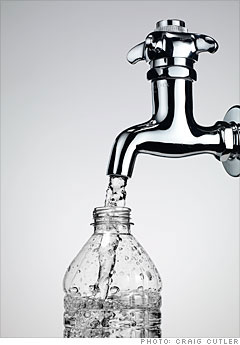
Water bottles are bad, so why are you still using them?

I recently came across an article about bottled water, and it provided me with even more reasons not to use them. If you or someone you know still uses bottled water, you need to read this, or share this article with them.

1) Bottled water is not tested, nor do the companies have to tell you where they get it from. Tap water is regulated, and your city must submit reports to the EPA listing the results, and disclose the results to the public. Laboratory results of bottled water have shown far worse performance than tap water. A company could literally fill up bottles from the tap and sell them as "Pure Glacier Stream" and you would have no idea if that was true or not. Approximately 25% of bottled water comes directly from municipal (city) tap water.


2) It's expensive. The average price of bottled water is 240-10,000 times more expensive than tap water. Per gallon, it is more expensive than gasoline! Over 90% of the cost of bottled water is associated with the bottle, lid and label.

3) Plastic bottles made from PET and Tetra Paks have a higher rate of leaching into the bottled water, the longer it sits in the container. The results continue to come in, and they don't look good. Many of the leaching substances are hormone-mimicking, like estrogen.

4) Most people cannot taste a difference. Here is a blind statistical study we conducted that compared bottled water, tap water and filtered water. Our testers could not taste a difference.

5) Water bottling companies destroy the water aquifers of communities. Most of the water bottle companies are large corporations, like Coca-Cola, Nestle, and Pepsi (to name a few). They come into a community, extract the water for almost no cost, dry up the ecosystem, then take their profits and leave.

6) Manufacturing the plastic bottles (from oil), pumping and filling the bottles, packaging and transporting the bottles greatly increases carbon emissions. Most of the time, the bottles are shipped far away from where the water is collected and filled, so this can have a huge impact on our carbon footprint.

7) Most plastic bottles are STILL not recycled. Only 1 out of every 4 bottles (about 25%) are actually recycled. Even if that number was 100%, recycling doesn't make the problem go away. We need to REDUCE our usage, to avoid the carbon impact in the first place (see #6)

Recommendation: Use a reusable aluminum water bottle filled with filtered tap water. You may not even need to filter the water depending on where you live.

Here is a good pamphlet developed by the Sierra Club that summarizes these same arguments against bottled water.

Saturday, July 2, 2011

Solar powered coffee van coming to a town near you?

I recently stumbled upon a mobile coffee company this week, near where my wife works.

Besspresso is a solar and biofuel (soy-based) powered green van that serves a blend of organic, fair trade, and sustainable wood roasted coffee and various espresso drinks. They serve their coffee in 100% biodegradable corn and plant based cups.


They originated near Portland, Oregon a few years ago, but the new owners are taking it all over the United States. They will be here in Iowa City for a few more weeks, then off to Tempe, Arizona for the remainder of the year. They will also be making stops at various music and environmental festivals this summer.

They offer a relaxing atmosphere to enjoy coffee outdoors, and listen to music through their high quality loudspeaker system.

To learn more about their service, and where they are located now, visit their website at: http://www.solarespresso.com/


Wednesday, June 29, 2011

Top 4 reasons why trees are awesome!

I recently saw a presentation from Trees Forever, a local organization focused on trees (of course). They explained the benefits of trees, but I really had no idea about ALL the benefits a tree provides.


The message focused on four main areas how trees help us out:
  1. Save energy by reducing utility bills
    • provide shade to reduce air conditioning needs in summer
    • reduce "heat island effect" in cities with lots of cement (also reducing air conditioning)
    • slow down winter winds to reduce heating needs in winter
  2. Reduce stormwater run-off into streams and rivers
    • Rain is intercepted by tree leaves, slows down amount of rain that lands on the ground
    • Rain is absorbed by tree roots, instead of drained into streets
    • Tree roots make dirt more porous, allowing faster absorption of rain into ground (and back into aquifers after being cleansed and filtered by the soil)
  3. Reduce carbon dioxide (CO2) escaping into atmosphere
    • Trees need carbon to breathe so the more there are, the less that escapes
  4. Property value increase for your home when you have:
    • Mature trees (about 2% increase for medium/large trees in your yard, up to 15% increase in high income neighborhoods)
    • Trees in the front yard (about 3-5% increase)
    • Good tree coverage in the neighborhood (about 6-9% increase)
They didn't even get into the other benefits of trees, such as improved air quality, calming effect for children, recovery time for hospitalized patients, wildlife habitat, or the multiple purposes it serves as a raw material (heat, paper, goods, fruits, etc).

So it definitely pays to invest in trees in your yard. The rule of thumb they provided was a 4:1 ratio, so for every $1 you spend on a tree, you'll get $4 in savings. To learn more about the financial benefits of trees, visit TreeBenefits.com to calculate what you can save long term.

Visit Trees Forever to learn more about their organization.

Saturday, June 18, 2011

Philadelphia Eagles set the bar high for sports industry

One of the last industries you think of for promoting sustainability is the sports world. Players and fans flying and driving all over to attend games in large air-conditioned venues with lots of lights, huge amounts of concession stand food in disposeable containers.

One team is stepping out and taking the lead towards sustainability, the Philadelphia Eagles of the National Football League (NFL).


In 2003, the Philadelphia Eagles owners, Jeffrey and Christina Lurie, decided they wanted to make the Eagles more environmentally responsible.  They had the insight to see that they could make a difference, and set the team apart from others with a program called “Go Green!”

The Go Green! initiative focuses around some key initiatives: renewable energy, energy efficiency and conservation, recycling and waste reduction, reforestation (tree planting), and procurement decisions.
To start with, the Eagles offset their carbon emissions for the 2010 season through the GoZero program, which is managed by the Conservation Fund organization. They had been working their way up to 100% offset over the years. In 2009, the Eagles ran 100% of their operations on wind and solar, a small portion of which comes from their solar array at the NovaCare Complex, which produced 12,757 kilowatt-hours (kWh). In addition, they have cut their stadium’s annual electricity use by nearly 50% since 2004 through energy conservation and efficiency improvements.
The Eagles also created the country’s first Renewable Energy Employee Benefit Program, which encourages all full-time Eagles employees to purchase renewable energy credits (REC’s) from Delaware Valley region energy. The program compensates employees by paying the difference in price between current and renewable energy. In 2009, more than half of the organization’s eligible employees took advantage of this program.
In 2008 and 2009, the Eagles offset 100% of the greenhouse gas generated by team travel (air, bus, train and hotel) through tree planting. Their tree planting efforts take place at Eagles Forest, a 6.5-acre site at Neshaminy State Park in Bensalem, Bucks County, Pennsylvania. It contains more than 4,000 trees and shrubs, including over 150 trees that have been purchased by Eagles fans. They are also sponsoring tree plantings in Louisiana’s Lake Ophelia National Wildlife Refuge in Marksville, Louisiana, and helping with restoration projects in that area due to the recent oil spill in the gulf.

In 2009, they launched a composting program, in conjunction with their cafeteria service provider. They capture unwanted and disposed of food, and utilize compostable or post-consumer recycled content for utensils, plates and cups. In addition, the cooking oil is sent out for conversion to bio-diesel. They are also using environmentally preferable cleaning products to clean the food service and facilities areas. Along with a strong recycling program that has been in-place since 2003, they are getting very close to achieving a zero-waste operation.

In the office area, they have also made strides in reducing paper usage. They reduced newsletter publications by 36 tons of paper by moving more of the publications to online. They also moved to a digital media guide, saving more than 200 trees. They also increased the post-consumer content of the following items: game day programs, office printer paper, business cards, memo pads, invoices, staff handbooks, stadium credentials, facial tissue, hand towels, toilet paper, stadium maps, event staff birthday cards, tickets, cardstock and certain envelopes.
The efforts continue with the cheerleaders. The 2010-2011 Eagle Cheerleaders calendar was the first in the league to be printed on post-consumer recycled paper. The 38 cheerleaders are wearing eco-friendly bikinis made from organic cotton or recycled plastic bottles, with accessories (earrings, necklaces and bracelets) made from recycled materials such as CD's and computer chips. Additionally, 10% of the calendar sales will go to the Gulf Restoration Network to help protect and restore the natural resources of the Gulf for future generations.
Finally, one of the key activities that got the effort moving was the Carbon Neutral game, which took place in 2005 between the St. Louis Rams and the Eagles. The teams worked with Natural Resources Defense Council (NRDC), StopGlobalWarming.org, and NativeEnergy to offset the energy usage for a single game. They agreed to use clean energy from a Native American wind project in the Midwest, and energy from a Pennsylvania dairy farm methane project.
They determined that a single game produced 58 tons of carbon dioxide (CO2) pollution. The majority of the energy during the game came from heating the dome (wintertime in St. Louis), and running the huge lights during the game.  However, fans, media, and teams traveling by air, bus, and car to the game had a much greater impact. They estimated that travel took up more than 10,900 tons of CO2 – about 99% of the event's total carbon footprint.
Hats off the Eagles, and especially Christina Lurie, for her drive and determination to make this happen! I hope that other teams pay attention, and start competing with them in their sustainability efforts, not just on the football field. 

Saturday, May 21, 2011

Offset your carbon emission usage to feel better and make a difference

I was a little leary of carbon offset programs, but as I read more into Carbonfund.org, they have a very rigorous process for validating projects. Even though I do drive a Prius, I do impact the environment with the gas I purchase and consume. I also commute 25 miles each way, five days a week, so those miles add up to about 15,000 per year.

Therefore, I decided to offset the last years worth of driving. According to their calculator, I have contributed almost 3 metric tons of CO2 to the environment in the last year. To offset that amount, I had to pay about $30, or around $2.50 per month. That seems very reasonable to me, and it helps me feel slightly better about my driving habits.

Don't get me wrong. Paying someone to allow me to continue my bad behavior is not the intent. The alternative is that I don't spend the $30 on anything related to the environment, so I'm letting them do it for me. I don't want to pay that amount each year (as affordable as it is), so there is some incentive for me to continue to find ways to reduce my driving.

If businesses and companies were forced to offset their carbon footprint each year, imagine how many projects we could get started? For example, my company generates about 150,000 metric tons per year. If they paid $10 per metric ton (which is what CarbonFund.org charges), that would be about $1.5 million! Imagine how many solar and wind projects we could implement with that kind of investment! (As a side note, my company has set aside $500,000 to fund energy reducion projects this year, which is a great start).

Sunday, May 1, 2011

Good movie about where electricity comes from


We attended a green expo today, and one of the sessions was a 1-hour video called "Kilowatt Ours: A Plan to Re-Energize America", which was made in 2007. I hadn't even heard of it before, but I was very impressed with it.

The movie, created by Jeff Barrie, explores the source of our electricity and the problems caused by energy production including mountain top removal, childhood asthma and global warming. He walks through step-by-step how you can reduce your energy usage in your home and learn more about "green" renewable energy. 

One of the better parts of the movie was the discussion about energy conservation that many cities have taken on. Instead of building new power plants to address their increasing energy demands, the city of Austin, and the state of California spent a fraction of the power plant construction costs on education and rebates. In Iowa, we are having the discussion right now about building a new nuclear plant to meet our increasing energy demand, so that really hit home for me.

You can also download a classroom exercise for grade school kids, that corresponds with the movie
http://www.kilowattours.org/curriculum/KilowattOurs-Challenge-Activity.pdf

You can learn more about the movie at http://www.kilowattours.org/

Sunday, August 22, 2010

Crete renewable energy makes up for shortcomings

My wife and I got a chance to vacation to the island of Crete, the biggest island in the Greek Isles, located in the Mediterranean Sea. The weather was incredible, the scenery was mountainous and amazing, and the water was warm and clear. The local people were very friendly and spoke excellent English, so it made the trip very enjoyable.

What I didn't anticipate was the amount of renewable energy available in Crete. We saw many applications of green technology.

Almost every home had a passive solar water heater system on the roof, which means they aren't spending money on heating their water. With the amazing weather we experienced, it seems like a no-brainer to implement that everywhere in the Mediterranean.


We saw at least 100 wind turbines on the mountain tops, and probably 5-6 different wind farms (on the east side of the island only). It was pretty impressive. The good thing is that they didn't need huge towers to get them way up in the air, since the mountain was already high enough for constant wind. That probably keeps the costs down.


We also passed by a solar photovoltaic farm, with maybe 10-20 large panels. It was hard to get a picture of it due to the road we were travelling on, but it looked very impressive.

A couple observations about Europe:

1) they limited the use of ice. Every time we ordered soda or a water, we got 2-3 cubes, which melted quickly. I'd consider that a savings on the use of energy to generate all the ice cubes, even though it might not help the customer satisfaction for those of us used to having a drink that has too much ice.

2) Most hotels had a switch that required the room key, in order to turn on the electricity. This forced you to turn everything off when you left the room, by removing the key from the device. The only downside was when we were trying to recharge something (cell phone, laptop, etc), we could only do it when we were physically there. Overall, I like the idea, and would like to see it expand to the US.

I was looking for a website that summarized the renewable activity in Crete, but was unsuccessful. Maybe it's available on a website written in Greek. If anyone can find one that talks about the number of wind farms and turbines, solar arrays, solar water heaters, etc in Crete, I'd appreciate it.
Now to the negatives. In general, I did not see many places to recycle. We actually had to save up all our stuff, and take it to the Scandinavian resort up the hill, where they had many different bins all over the place for recycleables.

It might help the second problem as well, which is the amount of trash lying around. Along every street and highway you could see trash, bottles, cans, and many other items that shouldn't be there. If your primary economy is based upon tourism, I would think that cleanliness would be a primary focus.

Fortunately, most of the beaches were trash-free, except for the last beach we stopped at, on our way to the airport.

As you can see from this photo, it looks amazing, so we stopped right away to check it out. Crystal clear waters, cool rock formations, and ocean as far as you can see.


However, when you get up close, this is what we saw everywhere.

Trash bags, food packaging wrappers, styrofoam, plastic silverware, and other small plastic pieces that would surely be eaten by marine life. It was really gross. I would only get into the water up to my waist, and even then, I was not comfortable. We grabbed as many large objects as we could find, but it would take an army to clean it up.

I don't know how it got there. I don't even blame the locals, since it could be coming from the cruise ships or tourists. However, I would not recommend anyone go to that particular beach (Voulisma Beach) because of the trash we saw. This needs to be addressed right away. To have a beautiful island ruined by litter and trash would be a shame.

Sunday, July 18, 2010

Rapanui Clothing is putting the "cool" in Ethi-cool

An ethical fashion brand has unveiled a new range of clothing. The small Isle of Wight (island off England's southern coast where I visited recently) brand have been trading officially for two years, concentrating on sustainable textiles and buying.


Rapanui was set up by brothers Rob and Mart Drake-Knight in early 2008. It has quickly grown into an award-winning brand, earning recognition at the Sustainable Business Awards for their commitment to using organic, natural fabrics, wind-powered factories, and Fairwear Foundation audited supply chains.


Their cool new designs are geared to captivate the younger generations, who are perhaps less aware than others of where their clothes come from.
They are completely open an honest about the entire process of their clothes, how they are made and what impact each piece has on the environment, yet at the same time, they provide garments that perhaps you wouldn’t expect from a company whose main concern is about reducing the environmental impact of the fashion industry.

Check them out at Rapanui Clothing

Sunday, June 27, 2010

Iowa wind farm impressive up close

I got a pleasant surprise driving up to a family vacation. We drove through Charles City, Iowa, and ran smack into a huge wind farm.


Mid-American Energy built a total of 50 huge turbines, which produce about 75,000 KW of electricity. The wind farm was constructed in early 2008.

We also saw an even larger windfarm on I-35, near the Minnesota/Iowa border. I think it is called "Top of Iowa" (there are maybe three different "sites" within the same area). Started almost 10 years ago (built in 2001), it contains a total of 147 turbines.

I couldn't believe that it's been that long in service. Wind farms were the last thing on my mind in 2001, so hats off to those who got this farm up and running back then.

It's pretty awesome to see so many of them at once. Some of my family described it as "alien" or "spaceship" looking. If you have the opportunity to visit a wind farm, it's worth it. Just to see the landscape lined with rotating turbines, and to see how large they are. It's also cool to know that Iowa is one of the leaders in wind power in the US, and that each turbine is helping meet our energy needs, without pollution.
For more information, visit this List of Iowa Wind Farms